

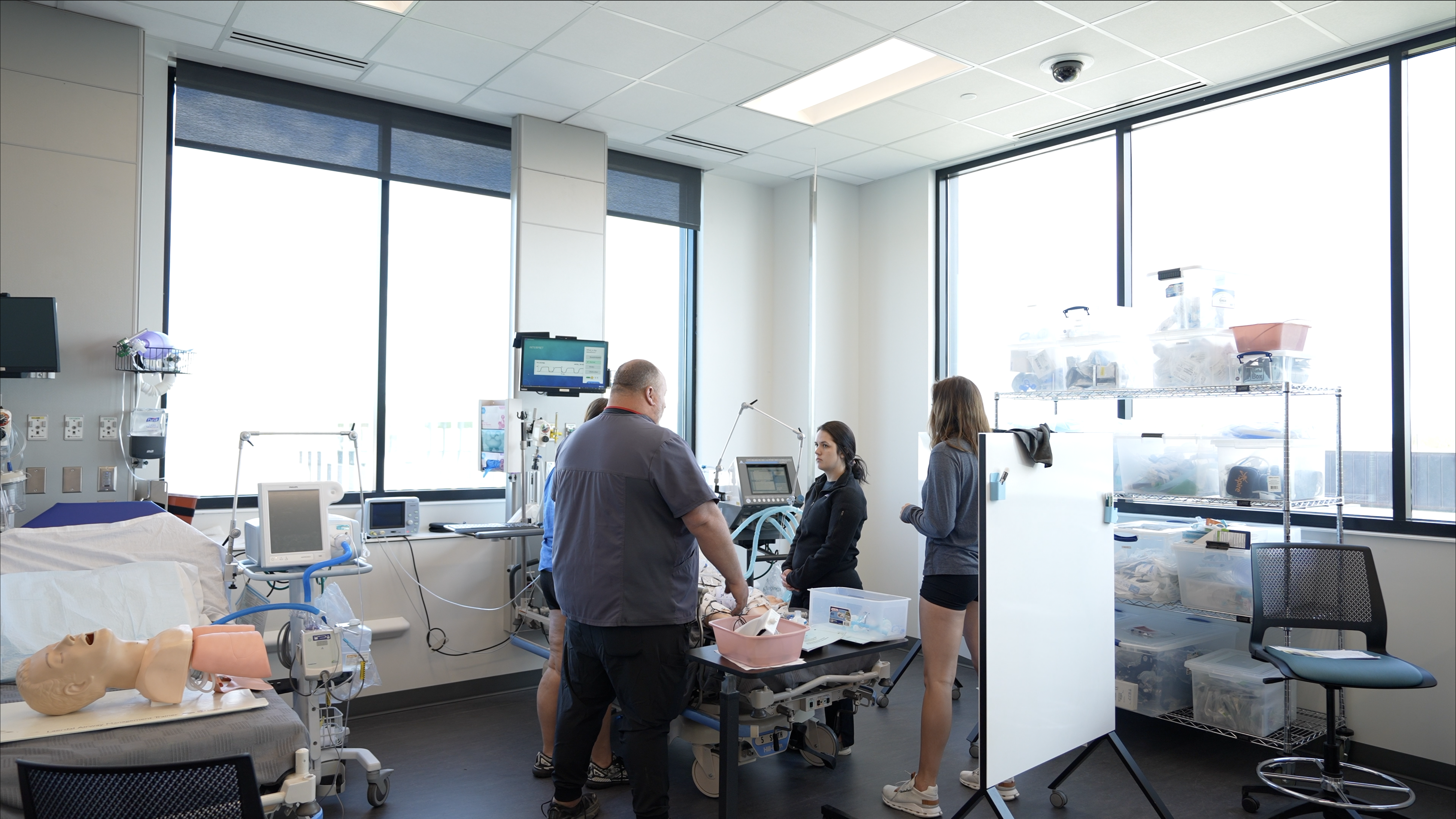
Across the country, community colleges are placing simulation and video technology at the center of their planning.
Program directors are reaching out to IVS earlier in the planning process, capital project teams are looping us into design conversations sooner, and colleges that would have started with a single lab a few years ago are now planning multi-program deployments from the outset.
We’ve identified four forces driving this increased interest. Let’s take a look at what they are.
1. The Growing Demand for Healthcare and Workforce-Ready Graduates
Workforce shortages in healthcare and skilled trades have moved from long-term projections to near-term operational problems. Community colleges are being asked to close this workforce gap, and enrollment growth reflects it.
Key employment statistics reveal the gaps in the American workforce:
- For every five workers that retire from manufacturing, construction, and other skilled trades, only two workers are available to replace them. By 2030, the U.S. Department of Education anticipates 2.1 million skilled trades jobs could go unfilled, with potential economic losses reaching $1 trillion annually.
- Nationwide, the projected supply of licensed practical nurses (LPNs) is sufficient to meet just 70% of the demand. The LPN shortage is projected to continue through 2038, if not longer, according to Health Resources & Services Administration projections.
- Diagnostic imaging programs continue to operate below capacity nationwide due to worker shortages. The radiologic technology training pipeline has not expanded in more than a decade, but it is not due to a lack of opportunity. The 600 or so accredited community college radiology programs in the US generally have program waiting lists, but their facilities have finite capacity.
Filling those workforce opportunities means pushing enrollment up in nursing, allied health, EMS, and skilled trades programs at community colleges. Growth is happening at institutions that already had thin faculty coverage and constrained facility space, which is where simulation and video technology becomes practical rather than optional.
Learn more about how Southeast Community College has addressed workforce demand in a 15-county region by opening a new health sciences facility, housing 18 high-demand health science programs in our case study.
Workforce needs are only one type of external pressure that community colleges are currently facing. The next factor focuses on increased demands from accreditation organizations.
2. Increased Pressure to Demonstrate Student Competency and Outcomes
Community colleges face growing pressure to demonstrate that their students are ready for real-world environments, not just credentialed. Accreditation and accountability demands have tightened across nursing, allied health, and CTE programs, including:
The Accreditation Commission for Education in Nursing (ACEN) has released Policy #39 High Stakes Testing, which will go into effect September 1, 2026.
- The Commission on Accreditation of Allied Health Education Programs (CAAHEP) accredits programs across 31 different allied health professions, with each governed by one of 25 specific Committees on Accreditation (CoAs) for allied health programs. CAAHEP accreditations are continuously refined to reflect changes across those professions.
- CTE programs are now broadly subject to more requirements, including program reviews, outcomes reporting, and evidence of student competency rather than just the completion of checklists and instructor sign-offs.
- Overall accreditation and outcome-based shifts are parts of a broader move toward competency-based education, where the question is less about how many hours a student sat through and more about what they can actually do. Documenting required student activities has traditionally been the harder half of affirming student competency.
Integrating A/V technology assists in completing new accreditation and competency requirements, making this process more efficient and accessible for faculty as well.
When a student's skills demonstration is captured on video, the evidence is durable, reviewable, and consistent across cohorts and instructors.
Two evaluators can watch the same session and align their scoring. New faculty can be brought up to speed on what "at standard" actually looks like, and recordings can be pulled into program review with the same specificity they had when they were captured.
The JMU Applied Behavior Analysis graduate research team used VALT's archived recordings and tagging features to review their own sessions and align inter-rater scoring. Read ourJMU Applied Behavior Analysis case study to learn more.
Many community college students now gravitate toward programs that have integrated learning technologies that accommodate their busy lives. Let’s take a look at the real impact this interest is having.
3. Demand for Flexible, Hybrid, and Technology-Enabled Learning Environments
Community college student life often looks much different than life at traditional four-year universities. According to the American Association of Community Colleges, more than 60 percent work while enrolled, and roughly one in four are raising children. Many commute from further away than students at four-year institutions, often multiple times a week, rather than living on or near campus.
Real-life student responsibilities have always shaped how community colleges deliver instruction, but the pandemic made asynchronous and hybrid learning true learning options. Students who miss a class because of a work shift or a sick child need a way to catch up, review, and demonstrate their skills on schedules that fit around the rest of their lives.
A/V technology makes that flexibility possible. Using simulation and video technology like VALT allows students to review recorded skills demonstrations at home, submit self-reflection videos for asynchronous review, and get feedback from instructors without needing both parties in the same room at the same time.
Integrating A/V technology into the community college environment also provides a faculty benefit: less time re-demonstrating basic procedures, and more time available for one-on-one work with the students who need it. Fortunately, the last area driving the interest in community college simulation and video technology is the variety of funding vehicles now available.
4. Increased Access to Funding: Perkins V, Workforce Grants, and Capital Investments
The fourth force is money, and there's more of it available than in previous years. Community colleges building or expanding simulation and video programs have several funding streams to work with, and the strongest projects usually tap into more than one.
Common funding sources that support the integration of simulation and video technology on community college campuses include:
-
Federal funding: Perkins V remains the largest federal source for career and technical education, distributed through state formula grants to local recipients. For CTE-aligned programs, this is often the anchor of a funding plan.
-
Workforce development grants: The Workforce Innovation and Opportunity Act (WIOA), U.S. Department of Labor grants, and Health Resources and Services Administration (HRSA) grants can help fund A/V technology integration and improvements in different programs at community colleges.
-
Public funding: Capital improvement budgets and bond measures often fund the largest projects, particularly anything tied to new construction.
-
External funding: Foundation gifts, donor support, and program-specific contributions can be paired with public sources to fund program expansions.
The pattern behind larger, campus-wide projects is almost always the same: multiple sources stacked together. Colleges that plan for stacking from the start end up with more room to build than those that plan around a single source.
For a deeper breakdown of specific funding sources, IVS maintains a Grant Funding Resource and a Grant Database Explorer that walk through each option in more detail.
Our recent blog, How Community Colleges Fund Simulation Labs and Video Technology: Perkins V, CTE Funding & Grants, also provides more information on the funding process.
Four Forces, One Goal: Integrating A/V Technology on Community College Campuses
None of these four forces is new on its own, but their convergence is unique. This combination is creating a strategic moment for community colleges. The institutions investing in simulation and video today are positioning themselves for the next several years of workforce demand, accountability requirements, student expectations, and funding availability.
For community colleges considering the move, IVS has resources that go deeper into each of these forces. Our Higher Education AV Capture Playbook covers planning and rollout, and the Grant Funding Resource walks through the funding side in detail. For colleges ready for a direct conversation, reach out to an IVS specialist or request a VALT demo to see what your A/V technology deployment could look like in practice.