
.png)
In honor of Healthcare Simulation Week, we are spotlighting the professionals who dedicate their lives to improving healthcare outcomes through training, skill development, and research. We sat down and asked questions about how they approach their career in simulation healthcare.
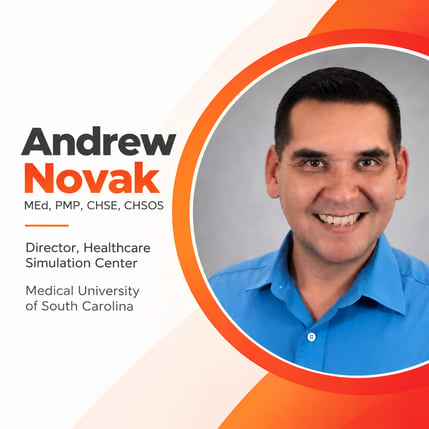
What inspired you to pursue a career in healthcare simulation?
"I did not plan on a career in healthcare simulation. I was working as a TASER officer in an emergency department when a simulation technician opportunity came up, and I applied without really knowing what the field was. I quickly fell in love with the diversity of knowledge and constant learning required to be successful. Fran Lee, DBA, CHSE, became an important mentor who saw potential in me, challenged me, and helped guide my growth from simulation operations into leadership."
How do you stay updated with the latest advancements and best practices in simulation technology and techniques?
"I try to stay connected to both the evidence and the people doing the work. I maintain my CHSE and CHSOS certifications, stay active with the Society for Simulation in Healthcare, attend conferences, review peer work, and learn from colleagues across the simulation community. I also make time to explore emerging technologies, especially AI, while asking a simple question: does this actually make the work, the learning, or the decision-making better?"
What are your goals to further advance the field of healthcare simulation?
"I want to help advance healthcare simulation by using technology more intentionally, especially AI and other emerging tools. I do not see technology as a replacement for leadership, expertise, or human judgment; I see it as a way to reduce friction, improve decision-making, and give people more time to focus on what matters most. At MUSC, my goal is to build a simulation center that is operationally strong, adaptable, and thoughtful about adopting technology where it genuinely improves education, operations, and the learner experience."
What have been your “aha” moments that have reshaped the way you approach simulations?
"One of my biggest "aha" moments came when I moved from Operations Manager to Director. I expected the next leadership level to be an extension of what I was already doing, but I quickly realized it requires a different mindset, new skill sets, and greater tolerance for ambiguity and competing priorities. Some lessons from military leadership carried over, but the transition reinforced that what makes you successful at one level of leadership does not automatically make you successful at the next."
What advice would you give to individuals who are interested in pursuing a career in healthcare simulation?
"There is no single path into healthcare simulation. My own path did not begin as a physician, nurse, educator, faculty member, researcher, or paramedic; I started as a simulation technician and learned the field from the operational side. Be curious, learn beyond your job description, find mentors who will challenge you, and take opportunities that stretch you. The diversity of backgrounds in simulation is one of the field's strengths, and your path does not have to look like anyone else's to be valuable."