
.png)
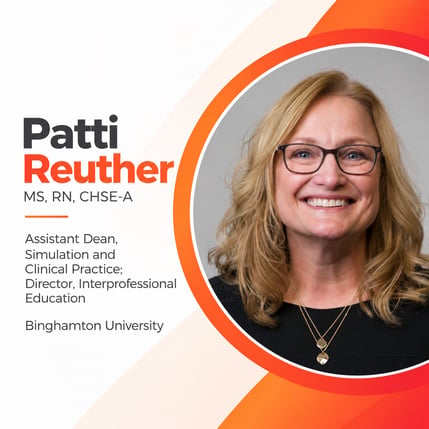
In honor of Healthcare Simulation Week, we are spotlighting the professionals who dedicate their lives to improving healthcare outcomes through training, skill development, and research. We sat down and asked questions about how they approach their career in simulation healthcare.
What inspired you to pursue a career in healthcare simulation?
"Healthcare simulation is the perfect marriage of my nurse and my nerdy sides. My first degree is in computer science. During my careers as both a systems analyst and a nurse, I found myself continually seeking opportunities to teach. Back to school I went. When I became nursing faculty, our simulation program was just beginning to develop, and it felt like a natural fit. I could see the potential of simulation and where the field was headed, and I wanted to be part of it."
How do you stay updated with the latest advancements and best practices in simulation technology and techniques?
"Attending conferences and staying current with the research are certainly important, but some of the best ideas come from collaborating with peers. There is tremendous value in sharing ideas, discussing new practices, and learning what others are trying. Those conversations often spark new ideas and led me to explore approaches that I might not have tried otherwise."
What are your goals to further advance the field of healthcare simulation?
"My goal is to make an impact on healthcare simulation education across the State University of New York (SUNY), not only in nursing, but across all healthcare related disciplines. As the largest comprehensive public university system in the United States, SUNY has an incredible opportunity to help shape policy, expand the adoption of simulation based education, and establish strong, evidence-based practices across disciplines and institutions. I want to help build the collaboration and infrastructure that can make that happen."
What have been your “aha” moments that have reshaped the way you approach simulations?
"I’m not sure there has been one particular “aha” moment. Our approach has evolved through experience, student feedback, and continuous improvement. We now place much greater emphasis on thorough prebriefing to support student success. We have also eliminated post simulation paperwork in favor of a brief, focused worksheet completed at the end of the experience.
Another important evolution has been our focus on inter-rater reliability and working continuously with faculty to ensure consistency in how student performance is evaluated. Rather than looking for a single “aha” moment, we focus on continually refining what we do based on what we learn from our students, our faculty, and each other."
What advice would you give to individuals who are interested in pursuing a career in healthcare simulation?
"No two days are ever the same! This is the best part of a career in healthcare simulation. It is also important to understand that working in simulation can be very different from a traditional faculty role. Simulation education is a boots on the ground experience. The workload and day to day responsibilities are different, but that variety is also what makes the work so interesting. For me, it has absolutely been the most interesting and rewarding experience of my career."