
.png)
In honor of Healthcare Simulation Week, we are spotlighting the professionals who dedicate their lives to improving healthcare outcomes through training, skill development, and research. We sat down and asked questions about how they approach their career in simulation healthcare.
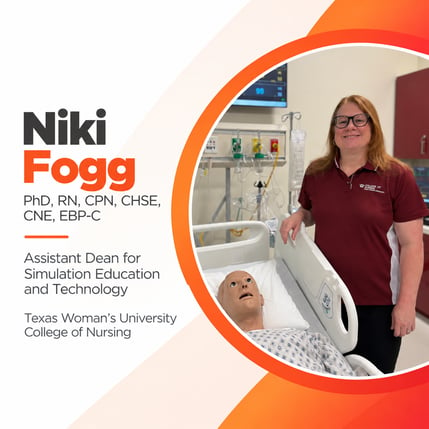
What inspired you to pursue a career in healthcare simulation?
"Simulation really found me through my love of teaching. As a pediatric nurse and nurse educator, I was always looking for ways to help students connect what they learned in the classroom to what they would actually need to do in practice.
What drew me in was seeing those moments when something finally “clicked” for a learner. Simulation gives students a place to think, make decisions, communicate, make mistakes, reflect, and try again without putting a patient at risk. Over time, what started as a teaching strategy grew into a passion for simulation education, faculty development, technology, research, and creating safe, meaningful learning experiences."
How do you stay updated with the latest advancements and best practices in simulation technology and techniques?
"I stay current through a combination of professional involvement, scholarship, collaboration, and curiosity. I’m actively engaged with organizations such as INACSL and the Society for Simulation in Healthcare, attend conferences, participate in committees and special interest groups, and regularly engage with the simulation literature and standards.
I also learn a tremendous amount from other simulationists. Our field moves forward when we share what works, what doesn’t, and what we learned along the way.
With technology, I try not to adopt something simply because it is new. I start by asking, “What learning problem are we trying to solve?” and then determine whether the technology actually helps us solve it."
What are your goals to further advance the field of healthcare simulation?
"One of my goals is to help move simulation from being viewed as an isolated learning activity to being intentionally integrated throughout competency-based healthcare education.
I’m especially interested in advancing simulation around clinical judgment, competency assessment, and interprofessional education. I also want to continue supporting the development of simulation educators and emerging leaders.
Ultimately, I hope to contribute to a field that is evidence-based, standards-driven, inclusive, emotionally safe, and thoughtful about how we use technology to improve learning and patient care."
What have been your “aha” moments that have reshaped the way you approach simulations?
"One of my biggest “aha” moments was realizing that the simulator is sometimes the least important part of the simulation. We have been very blessed with access to technology and equipment in our sim center, However, some of the most powerful learning experiences happen with very simple technology when the objectives, facilitation, and debriefing are strong.
Another was recognizing that psychological and emotional safety are not extras; they are part of good simulation design. Learners need to feel safe enough to think, reflect, ask questions, and be vulnerable. That same responsibility extends to simulated participants, especially children and families.
I’ve also learned to start with one simple question: “What does this learner need to be able to do when this experience is over?” That question keeps the focus on the learner rather than the technology."
What advice would you give to individuals who are interested in pursuing a career in healthcare simulation?
"Be curious, find good mentors, and say yes to opportunities to learn.
Healthcare simulation is incredibly interdisciplinary. You may find yourself learning about education, technology, psychology, theater, operations, research, and healthcare practice, and sometimes all in the same day.
I would encourage new simulationists to learn the why behind simulation, not just the how. Learn the standards, develop strong prebriefing and debriefing skills, understand psychological and emotional safety, and connect with the simulation community.
Most importantly, remember that simulation is ultimately about people, not equipment. You do not need the most expensive simulator to create a meaningful learning experience."